


Story Content
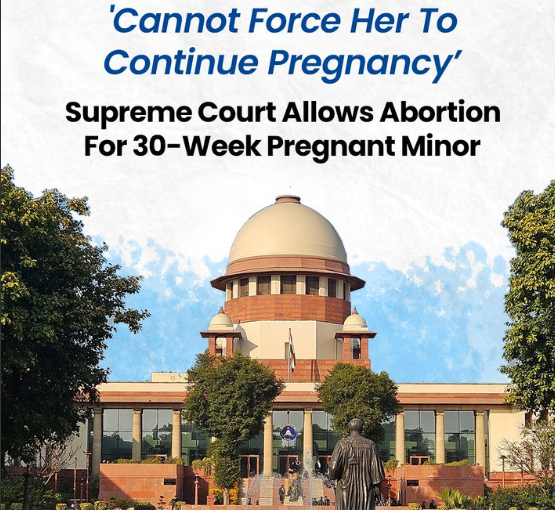
On February 6, 2026, the Supreme Court of India permitted the medical termination of a 30-week pregnancy of a teenage girl (who is now 18 years and 4 months old after conception at the age of 17) and denied a Bombay High Court order that had denied permission, in an important case law. In its ruling, the bench led by Justices B.V. Nagarathna and Ujjal Bhuyan highlighted that no woman, and in this case, a minor, could be forced to bear the unwanted pregnancy against herself, and thus her reproductive freedom, bodily integrity, mental well-being, and future were more important than the fetus.
The case concerned a consensual relationship, which was not legal because the girl was a minor during conception. The pregnancy was held to be ex facie illegitimate, and the girl had made her views clear that she was not willing to have the pregnancy carried to term. The Bombay High Court had previously ordered the pregnancy to be continued with the help and adoption opportunities after birth. This was overruled by the Supreme Court, where it was observed that compelling continuity would cause extreme mental trauma, physical danger, and even unsafe illegal terminations.
Observations made from the judgment:
Article 21 (right to life and personal liberty) provides that a key right as a fundamental right is reproductive autonomy, which includes decisional autonomy and dignity.
Courts cannot force motherhood or pregnancy continuation, especially among minors who have to deal with social stigma and trauma.
Under the Medical Termination of Pregnancy (MTP) Act, 1971 (amended in 2021), abortions can be done during the first 20 weeks (a single physician) or 24 weeks (two physicians, such as minors/rape victims). In exceptional cases above 24 weeks, courts can interfere on health risks and autonomy.
Our bench considered fetal interests but determined that the well-being of the girl, including the dangers of safe alternatives, went in her favor.
This process was allowed in J.J. Group of Hospitals, Mumbai, and was under stringent medical precautions, with the mother giving written consent.
This decision solidifies the rights of women in India by ensuring that reproductive choice goes beyond the law in extraordinary situations involving minors, trauma, or intense mental/physical consequences. It has prompted debates on the issue of fetal viability versus maternal choice and is praised as having been interpreted progressively, and there is some controversy about late-term fetal ethics.
The ruling goes in line with the changing jurisprudence on Article 21 in support of the fact that no body of law or the court can compel unwanted motherhood.



Comments
Add a Comment:
No comments available.