


Story Content
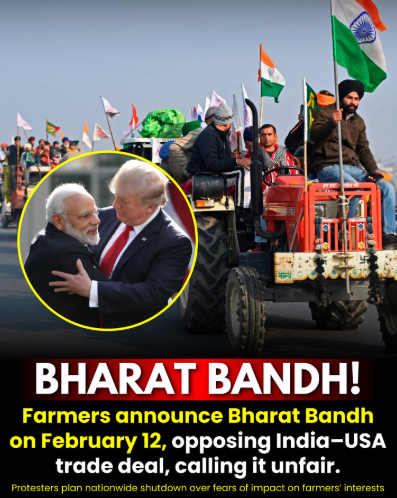
Farmer organizations in India have announced a nationwide Bharat Bandh (general strike/shutdown) on February 12, 2026, to protest the recently announced India-US interim trade agreement framework. The call comes amid widespread fears that the deal could severely impact Indian agriculture by opening markets to cheaper US imports, threatening the livelihoods of millions of farmers.
Key groups leading the protest include Samyukt Kisan Morcha (SKM)—the umbrella body that spearheaded the 2020-2021 farm law protests—its non-political faction, All India Kisan Sabha (AIKS), and allied farmer unions. SKM convenor Hannan Mollah strongly criticized the agreement, calling it a "total surrender" of Indian agriculture to American multinational corporations. He accused the central government of "surrendering before the shrewdness of the US" and demanded the immediate resignation of Commerce Minister Piyush Goyal, labeling the deal a "betrayal" against farmers.
The Bharat Bandh is part of a broader campaign starting from February 4, with village-level outreach from February 4 to 11 to mobilize support. Protests include burning effigies of US President Donald Trump and Prime Minister Narendra Modi in villages. SKM has also extended support to the nationwide general strike called by central trade unions on the same day, which could see participation from over 30 crore workers opposing "anti-worker, anti-farmer, and pro-corporate" policies.
What farmers are protesting against the deal.
The interim trade arrangement, announced at the beginning of February 2026, consists of India promising to lower or abolish the import duties on some animal-feed-related US agricultural goods (e.g., the dried distillers' grains, red sorghum, and soybean oil) for up to 10 years. Although the government says sensitive sectors will be safeguarded and there will be a benefit in food processing, energy connections, and exports (e.g., zero duty on $1.36 billion of Indian agricultural exports such as spices, tea, and coffee), farmers will suffer:
Torrent of low-priced US imports that threaten domestic prices.
Damage to oilseed refiners, peanut/soybean growers, the dairy industry, and small-scale farmers.
Millions of people in the rural areas of India lose their livelihoods and market shares.
Leaders of the opposition, such as the Congress's Randeep Singh Surjewala, added his voice to this, alleging it was a blow to the stomachs of the 720 million farmers in India.
Government Response
Commerce Minister Piyush Goyal came to the defense of the deal and mentioned that nothing is threatening the farmers and sensitive industries are being taken care of. According to him, it is a historic move written in gold letters when it comes to economic relations.
Disruption of roads, markets, transport, and everyday life throughout India, and predominantly rural and agricultural India, is possible due to the Bharat Bandh. The preparations are ongoing as of February 10, 2026, and there is a possibility of large-scale rallies and strikes. This is another point of conflict between farmers and governments after the repeal of laws created in 2021.



Comments
Add a Comment:
No comments available.