


Story Content
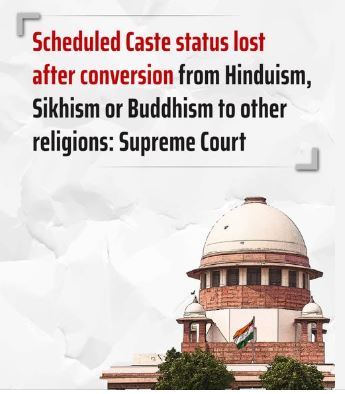
On March 24, 2026, the Supreme Court of India ruled in a landmark case that Scheduled Caste (SC) status can only be offered to individuals professing to Hinduism, Sikhism, or Buddhism. Any conversion to another religion causes the instant and total loss of SC status at the time of conversion, regardless of the place or time of the birth of the individual.
An order issued by the Andhra Pradesh High Court was upheld by a bench of Justices Prashant Kumar Mishra and NV Anjaria, who clarified Clause 3 of the Constitution (Scheduled Castes) Order, 1950. According to the court, the bar is categorical and absolute, and no individual not belonging to one of the three enumerated religions can be considered as a member of a Scheduled Caste and/or obtain any of the statutory benefits, reservations, or protection under the SC/ST (Prevention of Atrocities) Act.
The case in which the ruling was made concerned a Christian pastor who had sought protection under the SC/ST Act. The Supreme Court stressed that an individual cannot profess and practice a religion other than the three mentioned and at the same time claim to be a member of SC. The ruling should have some far-reaching effects on reservation practices and caste-based safeguards throughout the nation.



Comments
Add a Comment:
No comments available.