


Story Content
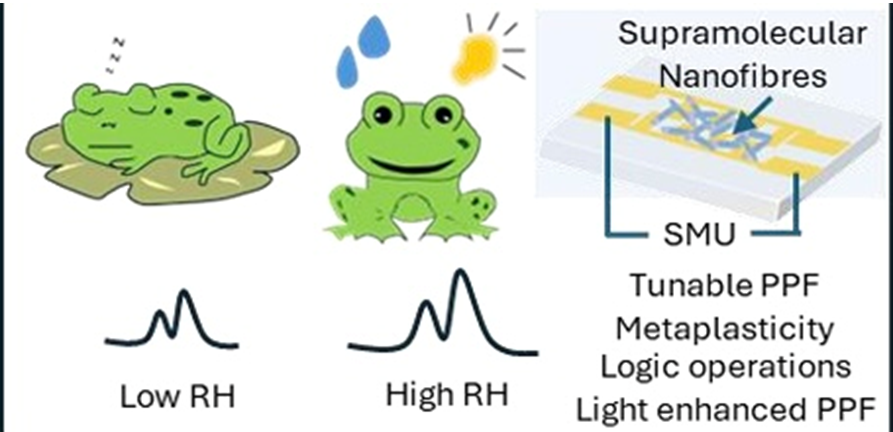
In another major stride in neuromorphic computing, scientists based at the Jawaharlal Nehru Centre of Advanced Scientific Research (JNCASR) have a humidity-sensitive, brain-like sensor, which works based on the behavior of the cricket frog. These amphibians regulate their activity according to the level of moisture in the environment, and the team imitated this characteristic in their inventive device.
The neuromorphic sensor is capable of detecting a humidity change, processing information, and storing information in one unit of source or neural system, like biological systems do. In contrast to traditional electronics that isolate these functions and use a lot of energy, this bio-inspired material saves energy needs and data-processing overhead to a large extent.
Under the leadership of Tejaswini S. Rao and Sukanya Baruah, the sensor works with specially designed nanofibers, which have been tested in conditions of controlled humidity. Published in the Journal of Materials Chemistry C, the development opens up the opportunities of making smart technologies in IoT devices, environmental monitoring, and edge computing energy-efficient.
Such an innovation fills the technology void between present silicon-based electronics and biological intelligence, and this technology could revolutionize the low-power AI and sensor applications of the future in India and elsewhere



Comments
Add a Comment:
No comments available.