


Story Content
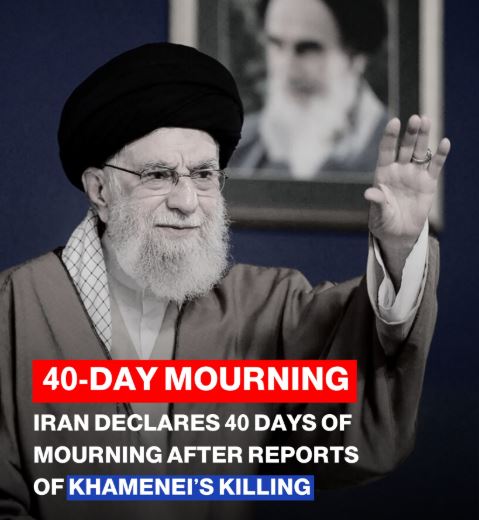
Iran has announced that it is under 40 days of national mourning after the death by precise airstrikes of its Supreme Leader Ayatollah Ali Khamenei, who was killed on February 28, 2026, just outside his Tehran home.
At 6:00 AM local time, state television IRIB broke into its program to announce the mourning decree, saying that all government offices, schools, universities, banks, and non-essential businesses will be closed on the first three days. The entire country will have flags flying at half-mast, special mourning sermons will be made part of Friday prayers, and the whole 40 days of the year have been cancelled as regards public entertainments.
However, the massive demonstrations have already taken place in the Valiasr Square and the Enghelab Square, as well as outside the Imam Khomeini Mausoleum in Tehran, where the masses were chanting, shouting, and waving portraits of the late leader, and the slogans read, "Death to America" and "Death to Israel." The same scenes have been reported in Mashhad, Qom, Isfahan, and Tabriz. The IRGC has also deployed more security personnel in managing the meetings to stop unrest.
The 40-day grieving period is a conventional Shia Islamic ritual (which is termed as Arba’een when given to martyrs), and there the ritual ceremonies, Quran readings, and processions are carried out in honor of the dead. The state funeral will take place in the next 72 hours, and as expected, senior clerics, foreign dignitaries, and representatives of the allied countries (including Russia, China, Syria, Hezbollah, and Hamas) are expected to attend.
The Assembly of Experts was called in emergency session to start the procedure of a successor selection. Names in question are President Ebrahim Raisi, Judiciary Chief Gholam-Hossein Mohseni-Ejei, and the son of Khamenei, Mojtaba Khamenei, but there has yet to be a frontrunner that comes out.
The officials of Iran have promised to continue the resistance more than ever before, and also they give a vow of retaliation against the US and Israel. The oil prices soared up by 8 percent in Asian trading due to fear of possible supply intervention, and world leaders gave mixed responses—congratulations from the Russian and Chinese capitals, silence from Western capitals, and a mouthful of apprehension from the Gulf states.
This period of mourning and political transition is quite long in Iran; therefore, the next few weeks will be the most crucial in revealing the future of the Islamic Republic against the backdrop of the increased tension in the region.



Comments
Add a Comment:
No comments available.