


Story Content
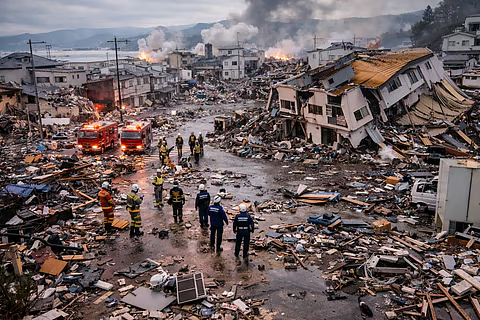
On Monday, at 4:53 pm, local time in the Pacific Ocean, off the northern Iwate Prefecture, a powerful earthquake caused a tsunami warning of up to three meters and a 5.6-magnitude aftershock that occurred approximately 40 minutes after the earthquake. ABC News
The quake had caused an 80-centimeter-high tsunami in Kuji Port, Iwate Prefecture, and a 40-cm-high tsunami in Miyako Port, Iwate. Waves were detected at Hachinohe Port in Aomori and at Erimo and Ayukawa Port in Miyagi Prefecture.
The earthquake that took place on Monday triggered Japan's disaster management agency to evacuate over 180,000. In areas affected, Takiyachi, the prime minister, called on those in the area to evacuate as soon as possible by claiming that the government was making its best efforts to determine the damage and deploy emergency disaster response efforts.
According to the top government spokesperson of Japan, Minoru Kihara, there were no instant casualties and big losses. The affected areas do not have any currently operating nuclear power plants, and there are no reported abnormalities at idled facilities.
A continuous advisory was made in the form of a rare "subsequent quake advisory" on 182 municipalities from Hokkaido to Chiba Prefecture, ordering people to re-verify evacuation plans. The likelihood of the magnitude of an earthquake of magnitude 8 or above has now increased by about 1 percent—ten times more than the risk of an earthquake is supposed to be with a probability of 0.1 percent—that is to last until April 27. The Japan Times
The catastrophic magnitude 9 earthquake and tsunami that befell northeastern Japan in 2011, causing the death of approximately 18,500 individuals and resulting in the Fukushima nuclear catastrophe, are still vividly remembered.



Comments
Add a Comment:
No comments available.